THE ENGLISH ORPHEUS
9 December (Wednesday) | 19:00 – 21:00
Sofia art institute
presents
The english orpheus
9 December 2026
7:00 pm
helikon art
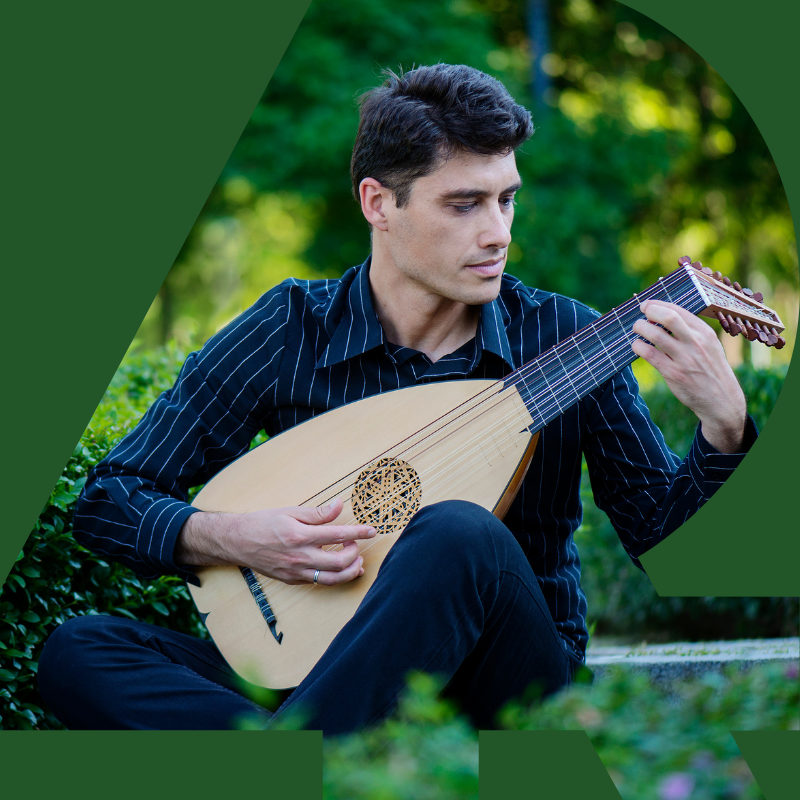
The Golden Age of Elizabethan England stands as one of the great cultural phenomena of Renaissance Europe. Music was among the arts that contributed most significantly to this distinction, with the lute serving as a particularly cherished and favored instrument—prized by professionals and amateurs alike.
Lutenist Yavor Genov will guide us through a gallery of musical tableaux, ranging from vibrant song melodies and melancholic harmonies to polyphonic abstractions. More than 400 years later, these sound portraits—capturing the contemporaries of Shakespeare and the tales of Renaissance England—are brought back to life. His program brings together three composers who left an indelible mark on this flourishing era of the arts: John Johnson, Anthony Holborne, and John Dowland.
part of “chamber concerts”
THE PERFormer
Yavor Genov, lute
The programme
Аноним XVI век
Pakington’s Pounde
I cannot keepe my wife at howme
Lost is my liberty
Greensleeves
John Johnson (~ 1545 – 1594)
Delight Pavan & Galliard
Carman’s Whistle
Johnson’s Jewell
Quadro Pavan
Without title
Gathering of peascods
Passingmeasures pavan
Good night and good rest
Anthony Holborne (~1545 – 1602)
A Pavan
New Year’s Gift
Fantasia
Almaine
Fantasia
Muy Linda
Heigh ho holiday
As it fell on a holiday
John Dowland (1563 – 1623)
Lord Strang’s March
Round Battle Galliard
Mrs. White’s Nothing
Lachrimae Pavan
Can she excuse my wrongs
What if a day
My Lord Willoughby’s Welcome Home
Tarleton’s Riserrectione
A piece without title
Go from my window
John Dowland’s Galliard
When the great late-Renaissance patron of the arts, Moritz, Landgrave of Hesse, dedicated a pavane to his favorite lutenist, John Dowland, he included the inscription in honorem Ioanni Doulandi Anglorum Orphei. The comparison to the mythical Thracian Orpheus – who could transform nature through the power of his music – was not unique to Dowland; during the 16th and 17th centuries, it served as a supreme tribute and a compliment to a musician’s talents.
The great flourishing of the Renaissance in England occurred several decades later than in the Italian city-states and France. Yet, this period is aptly termed a “Golden Age.” It is primarily associated with the reign of the last Tudor monarch, Queen Elizabeth I, and found its most vivid expression in music, literature, and drama, rather than in the visual arts. During the final decades of the 16th century and the beginning of the 17th, a distinct musical character emerged in England – one rooted, on the one hand, in indigenous traditions that predated the Reformation, and on the other, in the assimilation and adaptation of influences from the “Continent.” For instance, the first printed instructional books for the lute – which were translations – did not appear until the 1560s, just as the first generation of professional English lutenists was beginning to establish itself. Among these figures were John Johnson and Anthony Holborne; however, very little is known about their lives today. What they have in common is that they were born around 1545, dedicated a significant portion of their creative output to the lute, and served the Queen directly. John Johnson was one of the three lutenists in her court – a position for which John Dowland himself vied following Johnson’s death. In the prefaces to his two published music books, Holborne describes himself as a “servant to her most excellent Majestie.”
Dowland, by contrast, is one of the late Renaissance musicians whose life story is documented in the greatest detail – largely thanks to the man himself. He left behind a remarkable body of correspondence with his patrons, accounts in the prefaces to his musical collections, and veiled allusions within the poetry of his lute songs – works that were deeply cherished then, just as they are today. He was a welcome guest at numerous aristocratic courts across Europe and England; his journey to Italy to meet the great madrigalist Luca Marenzio has even become the stuff of legend.
The instrumental repertoire is, for the most part, typical of late 16th-century Europe. It is dominated by abstract compositions – such as preludes and fantasias – as well as the characteristic dance forms that would later evolve into the Baroque suite cycle: the allemande, the French courante (which was just coming into fashion), the gigue, and the pavan and galliard. This was the era when the lively, ornate Italian padovana evolved into the weighty, solemn English pavane – a form imbued with melancholy and often bearing titles suggestive of sorrow – while the galliard (a dance favored by the Queen) took on the character of a song, defined by vivid, memorable melodies.
John Dowland – an iconic figure representing not only the English lute school but the broader musical splendor of the age – passed away in 1626; shortly thereafter, the golden age of the lute in England began to wane. Today, 400 years later, the musical world is once again turning to his legacy – a musical language through which we can communicate with a depth perhaps nearly as profound as that experienced in his own time.
The program for this concert features music composed for the instrument favored by John Dowland, as well as by two of his contemporaries – John Johnson and Anthony Holborne – with whom he was undoubtedly connected. It offers a glimpse into the vast, intricate tapestry of the late Renaissance, and into that unique phenomenon on the cultural map of Europe known as the Elizabethan Golden Age.
Yavor Genov
Yavor Genov is a lutenist and basso continuo player. His six solo albums – The English Orpheus: John Dowland (2025), Nicolas Vallet – Lute Music (2024), Hans Neusidler – Lute Music (2022), Orpheus Anglorum (2018), Zamboni – Lute Music (2014), and Kapsberger – Libro primo di lauto – released by the Spanish and Dutch labels Emec Discos and Brilliant Classics, have received high praise from international critics.
His playing has been described as “intelligent and immediately touching” (American Record Guide) and as a “performance of the highest order” (Folk Bulletin). “Genov promises to be a force to be reckoned with in the lute world” (International Record Guide). He has performed with musicians such as Emma Kirkby, Núria Rial, Andrew Lawrence-King, Lars Ulrik Mortensen, and Teodor Currentzis. As a basso continuo player, he has performed with ensembles and orchestras including Utopia, EUBO, Cordevento, MusicAeterna, and the Valletta International Baroque Ensemble, among others. His appearances have taken place on some of Europe’s most significant stages and at its most prominent festivals, including the Salzburg Festival (Salzburger Festspiele), MA Brugge, Musica Antiga de Barcelona, the Festival Oude Muziek (Utrecht), the Berlin Philharmonie, the Bolshoi Theatre (Moscow), the Concertgebouw (Amsterdam), the Cité de la Musique and the Opéra National (Paris), and St. John’s Smith Square (London).
Yavor studied lute instruments and basso continuo with Jakob Lindberg, and later took lute lessons with Nigel North. He also works as a musicologist, focusing on the lute repertoire, Renaissance music theory, and medieval Gregorian chant. He has dedicated numerous articles and studies – as well as three monographs – to these subjects.
WITH THE SUPPORT OF

All guests at the event will be able to enjoy a glass of wine with compliments from Aya Estate Vineyards.
Important: Tickets are available only through advance sale on the Sofia Art Institute website.
Tickets will not be sold at the venue before the concert.
Seating is limited. The duration of the event is approximately 90 minutes.
The Chamber music concerts are a project of Sofia Art Institute and is presented with the support of Helikon Bookstores, Aya Estate Vineyards, and iPrint.
All concerts from the 2026/2027 season take place at Helikon Art, 6 Graf Ignatiev St., Sofia unless another location is specified.
If you would like to become a partner of the Sofia Art Institute, please contact us at [email protected].